Social Media Strategy8 min read
How to Build a Social Media Strategy That Actually Generates Leads
Learn how to build a social media strategy that attracts the right audience, builds trust, and turns followers into leads and customers.

Fahim Faisal Tarun
Posting consistently on Instagram, Facebook, LinkedIn, or TikTok doesn't automatically bring in customers.
A business can post several times a week, get likes and comments, and still struggle to generate a single meaningful lead.
The problem is usually not the amount of content. It's the strategy behind it.
A good social media strategy connects your business goals with the right audience, the right content, the right platforms, and a clear path toward becoming a customer.
In this guide, I'll walk through the process I use to think about social media marketing—from defining the goal to measuring what is actually producing results.
What is a social media strategy?
A social media strategy is a plan for using social platforms to achieve specific business goals.
Those goals could include:
- Increasing brand awareness
- Generating leads
- Driving website traffic
- Increasing online sales
- Building an audience
- Growing a local customer base
- Strengthening customer relationships
The important part is that social media should have a job.
If the goal is lead generation, for example, getting 10,000 views isn't necessarily more valuable than getting 500 views from the right people.
That's why I don't recommend starting with the question, "What should we post today?"
Start with:
"What are we trying to achieve, and what needs to happen on social media to get there?"
1. Start with a clear business goal
Before creating content, decide what success actually means.
A vague goal such as "grow our social media" isn't enough. It doesn't tell you what to post, who to target, or how to measure progress.
Instead, choose a specific objective.
For example:
- Generate 30 qualified leads per month
- Increase website inquiries by 20%
- Generate 50 product purchases from social media
- Increase qualified website traffic
- Build an audience of potential customers in a specific location
Your social media strategy should support the business, not operate separately from it.
If you're selling a service, your strategy might focus on generating inquiries and consultations.
If you're running an e-commerce brand, the focus might be product discovery, website traffic, conversions, and repeat purchases.
The goal determines the strategy.
2. Understand who you're trying to reach
One of the biggest mistakes businesses make is trying to create content for everyone.
You don't need everyone to follow you.
You need the right people to pay attention.
Start by understanding your ideal customer.
Think about:
- Who are they?
- What problem are they trying to solve?
- What does that problem cost them?
- What questions do they ask before buying?
- What objections might stop them from purchasing?
- Which social platforms do they actually use?
- What type of content do they respond to?
For example, a local salon, a SaaS company, a restaurant, and a professional service business shouldn't have the same content strategy.
Their customers have different needs, buying processes, and reasons for trusting a business.
The better you understand your audience, the easier it becomes to create content that feels relevant.
3. Build content around a purpose
A social media feed shouldn't be a collection of random posts.
Every piece of content should have a reason for existing.
A simple content framework is to combine four types of content:
Educational content
Teach your audience something useful.
Examples:
- Tips
- How-to posts
- Guides
- Mistakes to avoid
- Industry insights
- FAQs
Educational content helps establish expertise and gives people a reason to follow you.
Trust-building content
Show people why they should believe in your business.
Examples:
- Client results
- Testimonials
- Case studies
- Behind-the-scenes content
- Team expertise
- Before-and-after results
People often need several reasons to trust a business before they are ready to buy.
Engagement content
Start conversations and learn more about your audience.
Examples:
- Questions
- Polls
- Opinions
- Industry discussions
- Common customer problems
Engagement shouldn't exist just to increase the comment count. It should help you understand your audience and build relationships with potential customers.
Promotional content
Eventually, you need to ask people to take action.
That could mean:
- Book a consultation
- Visit your website
- Request a quote
- Download a guide
- Shop a product
- Send a message
- Sign up for an offer
A common mistake is making every post promotional.
Another mistake is never promoting anything at all.
The goal is to create a balance between value, trust, conversation, and conversion.
4. Choose the right platforms
You don't need to be everywhere.
In fact, trying to maintain five or six platforms without enough resources can make your content worse.
Start with the platforms where your target audience is most active.
For example:
- Instagram can be effective for visual brands, lifestyle businesses, creators, restaurants, beauty, fitness, and e-commerce.
- Facebook can be valuable for local businesses, communities, older audiences, and businesses using Meta advertising.
- LinkedIn is particularly useful for B2B companies, professionals, consultants, agencies, and personal brands.
- TikTok can be powerful for discovery-driven content and brands that can communicate effectively through short-form content.
The right platform isn't necessarily the platform with the most users.
It's the platform where your potential customers are most likely to notice, trust, and engage with your business.
 (opens full size in a new tab)
5. Create a realistic content system
Consistency matters, but consistency doesn't mean posting every day just because a calendar says you should.
A better approach is to create a system you can maintain.
For example, a business might publish:
- 2 educational posts per week
- 1 trust-building post per week
- 1 promotional post per week
- Stories throughout the week
- One stronger campaign or offer each month
The exact schedule will depend on the business.
What matters is having a repeatable process for:
Research → Planning → Creation → Publishing → Engagement → Analysis
A content calendar makes this much easier.
Instead of waking up every morning wondering what to post, you already know what you're publishing, why you're publishing it, and what action you want the audience to take.
6. Turn attention into leads
This is where many social media strategies break down.
A business may successfully attract attention but provide no clear next step.
Someone sees your post.
They like it.
They scroll away.
That's not necessarily a bad result—but if your goal is lead generation, there needs to be a path beyond the post.
Your profile should make it obvious:
Who you help → What you offer → Why someone should trust you → What they should do next
Your content can then direct people toward that next step.
For example:
- "Want help improving your social media strategy? Book a consultation through the link in our bio."
- "Download our free social media content planner."
- "Send us a message to discuss your project."
This is where content, profile optimization, landing pages, lead magnets, and calls-to-action start working together.
Social media doesn't have to close the sale by itself.
Its job can simply be to move the right person to the next stage of the buying journey.
7. Use paid advertising strategically
Organic content and paid advertising can work together.
Organic content helps you build credibility, understand what your audience responds to, and maintain a presence.
Paid advertising can help you reach specific audiences at scale.
But putting money behind a weak offer doesn't fix the underlying problem.
Before launching an ad campaign, look at:
- The offer
- The audience
- The creative
- The message
- The landing page
- The conversion process
- The follow-up
If someone clicks your ad and lands on a confusing page with no clear next step, the problem isn't necessarily the ad.
It's the entire funnel.
Think beyond "How much did I spend?"
Ask:
"What happened after someone saw or clicked the ad?"
8. Measure business results—not just vanity metrics
Likes and followers can be useful indicators, but they shouldn't be the only numbers you track.
Depending on your objective, monitor metrics such as:
- Reach
- Engagement rate
- Profile visits
- Link clicks
- Website traffic
- Leads
- Cost per lead
- Conversion rate
- Sales
- Return on ad spend
For example, imagine one post receives 20,000 views but produces no inquiries.
Another receives 3,000 views and generates 12 qualified leads.
Which one performed better?
If your objective is lead generation, the answer is obvious.
That's why your metrics need to match your business goal.
9. Review what's working and adjust
A social media strategy shouldn't be something you create once and never touch again.
Your audience changes.
Platforms change.
Offers change.
Content performance changes.
Your strategy should change with them.
Set aside time every month to review your results.
Look for patterns:
- Which topics generated the most engagement?
- Which posts drove profile visits?
- Which content generated website traffic?
- Which campaigns produced actual leads?
- Which formats consistently underperformed?
Then use those findings to improve the next month's strategy.
You don't need to guess what your audience wants when your own data is already giving you clues.
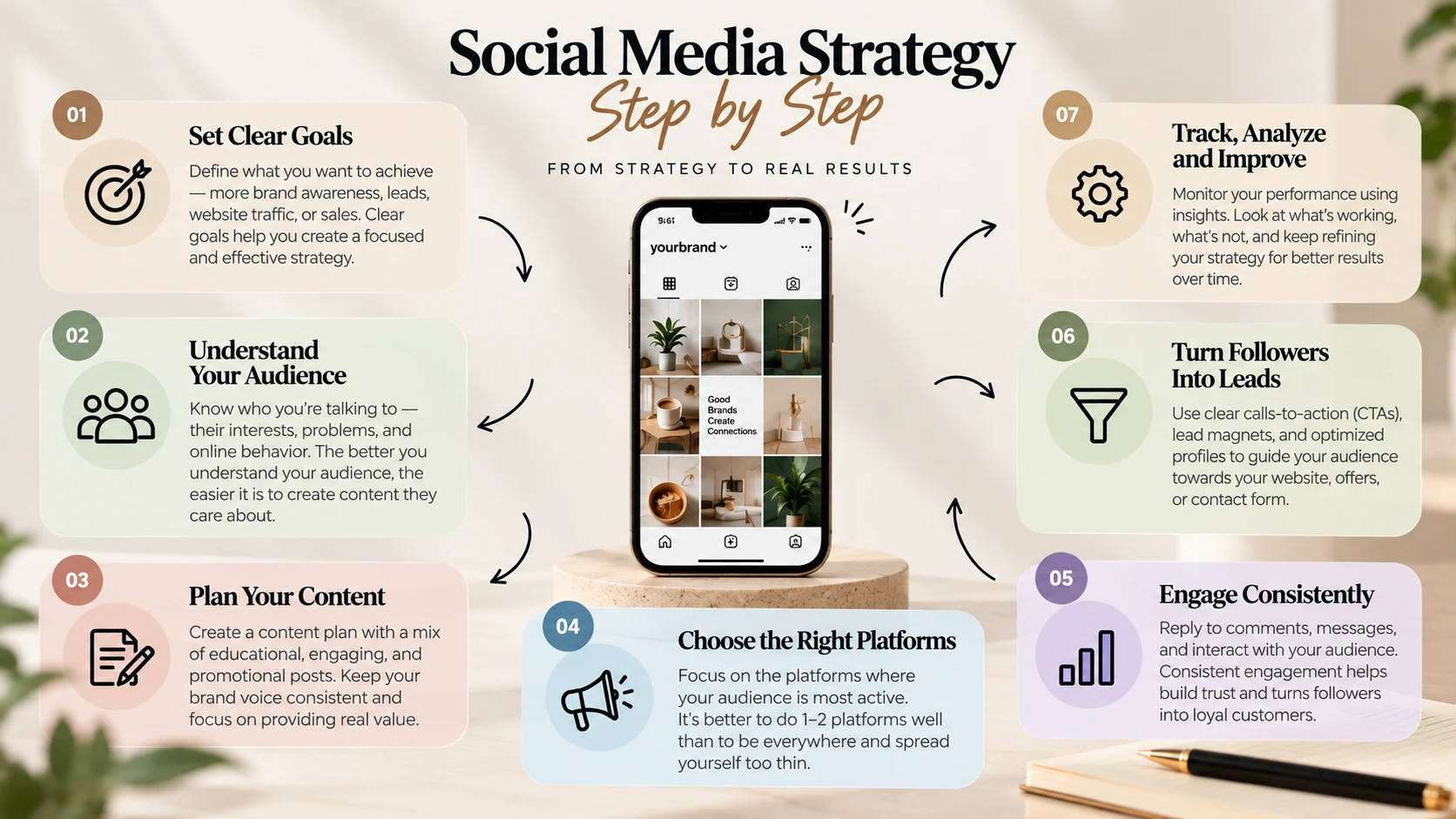
A simple social media strategy framework
If you're starting from scratch, keep the process simple:
- Define the goal. What business result are you trying to achieve?
- Define the audience. Who is most likely to become a customer?
- Choose the platforms. Where does that audience spend time?
- Build content pillars. What topics will you consistently talk about?
- Create a content calendar. What will you publish and when?
- Add conversion points. What should people do after engaging with your content?
- Measure and improve. Which activities are actually contributing to the goal?
That's the foundation of a social media strategy that can grow with your business.
Final thoughts
Social media marketing isn't simply about posting more.
It's about creating a clear connection between your business, your audience, your content, and the action you want people to take.
When those pieces work together, social media becomes more than a place to publish content. It becomes part of your customer acquisition system.
And you don't need to be active on every platform or publish dozens of posts every week to get started.
You need a clear goal, a good understanding of your audience, useful content, a consistent system, and a way to measure what is actually working.
That's where a strategy makes the difference.
Need help with your social media strategy?
If you're spending time creating content but aren't seeing enough traffic, leads, or customers from social media, the problem may not be your effort—it may be the strategy behind it.
I help businesses build practical social media strategies focused on content, audience growth, paid advertising, and measurable business results.
- #social media strategy
- #social media marketing strategy
- #social media strategy for small business
- #social media lead generation